
Envisioning a Resilient Future for a Historic Campus
Cherry Hospital
Project Summary
The goals of this project were: document the layered cultural, historical, and ecological significance of the campus; develop a vision for the future of the property that balances sensitive cultural and environmental contexts with the greatest public benefit; and illustrate potential future conditions and user experiences. The final report includes detailed site inventory and analysis highlighting the most important attributes, conditions, and vulnerabilities of the campus. Ultimately, these findings informed a long-term vision for the historic campus, which expands on three themes nested within the broader vision: conserve ecologically significant areas, strategies for campus redevelopment, and meeting unserved community recreation needs.
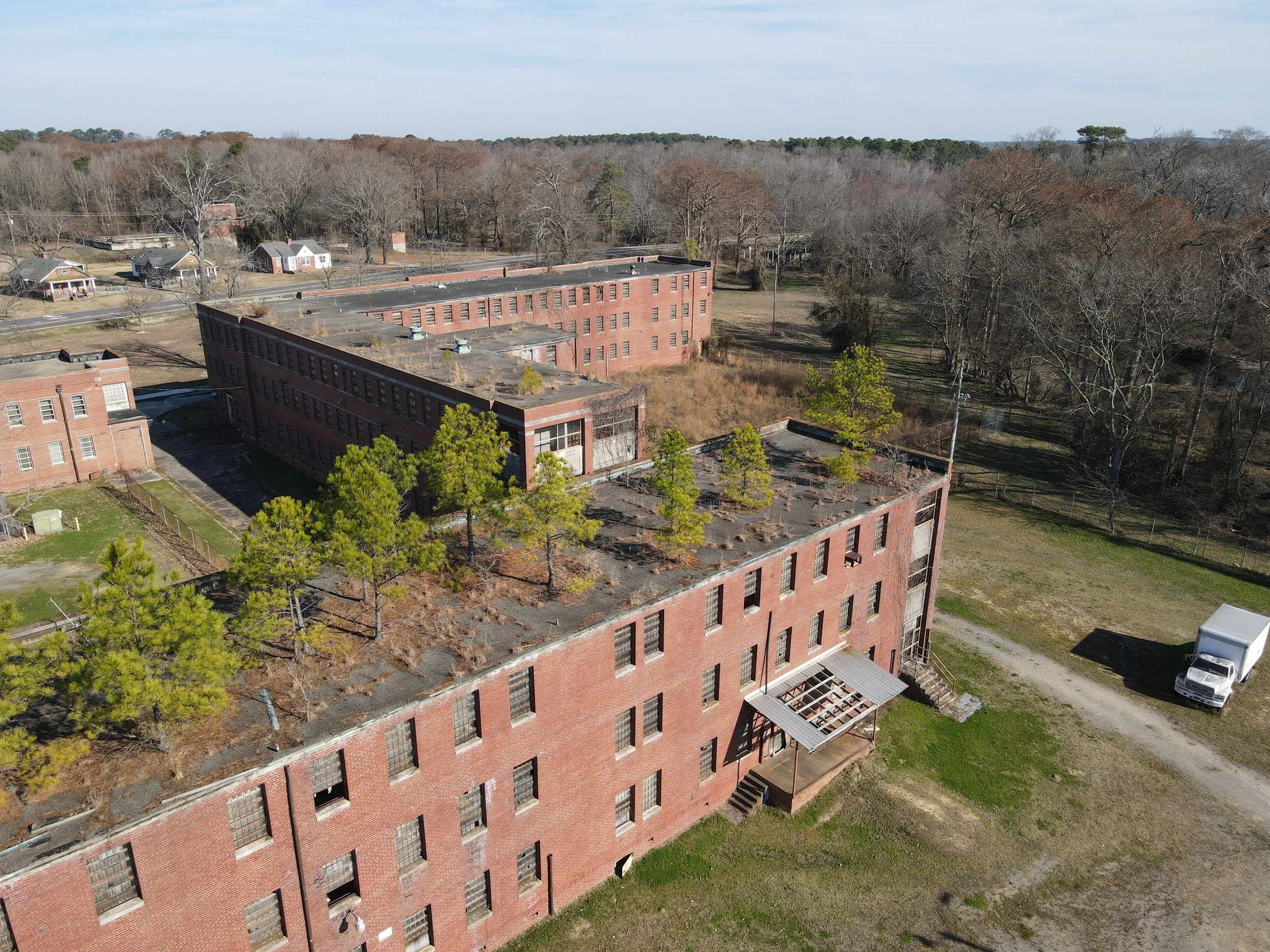
Cherry Hospital holds a significant place in history as one of the first three state-operated psychiatric hospitals in North Carolina and the only such hospital dedicated to providing care to the state's Black population. Since its establishment in 1880, Cherry Hospital has borne witness to evolving institutional psychiatric practices, including legacies of racial and medical injustices. Envisioning the future for the historic Cherry Hospital requires reckoning with its past and sensitively honoring this site’s histories and memories.
The State of North Carolina owns the property. After patients were moved into modern facilities constructed in 2016 across the Little River, most buildings on the historic campus were closed. The historic grounds consist of 170 acres, of which a substantial amount resides in the floodplain. As future use and ownership of the property is evaluated, it is crucial to consider the physical, historical, cultural, and ecological context of the historic campus, which includes underutilized land and buildings. This project addressed these issues on the campus and across the surrounding landscape. Inventory and analyses point toward recommended improvements that will enhance the study area’s long-term environmental and civic functions, local community, and broader watershed and resident ecologies. The final report uses a rich array of maps and illustrations to document and prioritize project focus areas for strategic acquisition and investment. Key elements of the study and plan include:
Burial Grounds
It is estimated that more than 3,800 patients are buried on the historic Cherry Hospital grounds, with marked and unmarked clusters of graves found throughout the property. Patients were buried on site when their relatives or friends could not be reached for an alternative site, and they often did not receive a ceremonial burial. The two documented burial sites account for patients interred after 1905.
A Site at the Confluence
The historic campus sits at a crucial point where the Little River meets the Neuse River, forming a large floodplain area that intersects with the City of Goldsboro’s western boundary. The hospital campus is entirely located within this extensive floodplain, which the vision plan accounts for in both its assessments and recommendations.
Existing Ecological Systems
The property’s eastern boundary is the Little River, a Registered Natural Area with a top ranking of ‘Exceptional.’ Out of 2,500 Natural Areas in the state, only 17% achieve the highest ranking. These areas are crucial for conserving the region’s natural biodiversity and contain some of the state’s best rare species populations, habitats, and natural communities. Only one-third of the exceptionally ranked designated natural areas in North Carolina are publicly accessible, therefore programming the site for public access provides a unique opportunity for the public to experience and learn about stewardship of such a vital natural resource.
The project’s findings resulted in a clear vision for the historic Cherry Hospital campus, which expands on three themes nested within that vision: conserving ecologically significant areas, highlighting potential for campus redevelopment, and meeting unserved community recreation needs. Collectively, the project's recommendations aim to celebrate the place-based opportunities unique to the historic Cherry Hospital campus and provide a framework for realizing the vision.
Project Start Year
2023
Location
Goldsboro, NC
Collaborators
Hydraulic Modeling: Barbara Doll, PhD, PE, and Jack Kurki-Fox, PhD, PE
Award
2025 Merit Award in Analysis & Planning: Cherry Hospital: Envisioning a Resilient Future for a Historic Campus, North Carolina Chapter of the American Society of Landscape Architects
Funding Sources
The Conservation Fund / North Carolina Land and Water Fund
Related Project
Sample Images


