Resilient Adaptation Strategies for North Carolina’s Historic Properties
NC Historic Resilience Primer
Project Summary
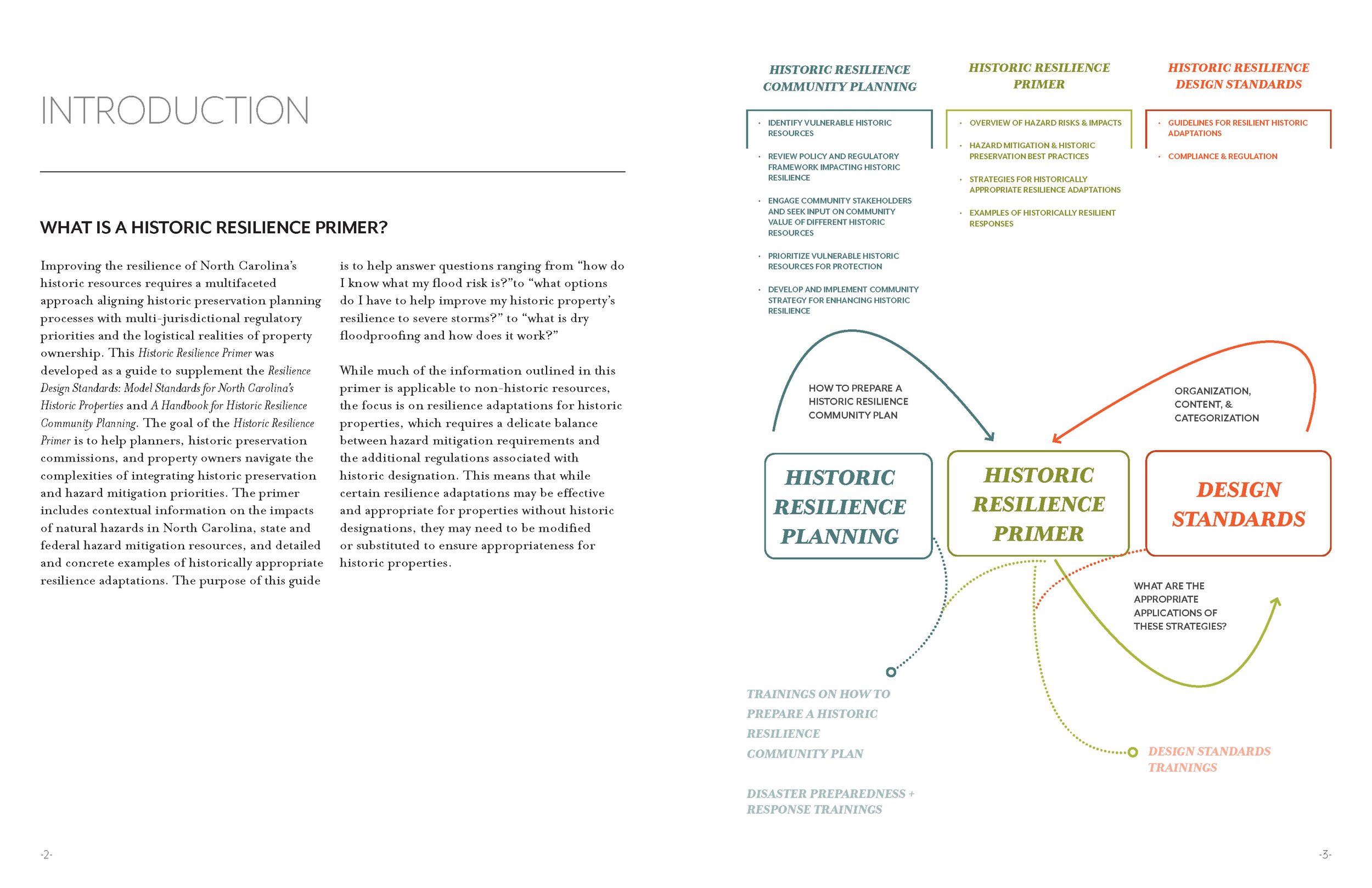
Improving the resilience of North Carolina’s historic resources requires a multifaceted approach aligning historic preservation planning processes with multi-jurisdictional regulatory priorities and the logistical realities of property ownership. This Historic Resilience Primer was developed as a guide to supplement the Resilience Design Standards: Model Standards for North Carolina’s Historic Properties and A Handbook for Historic Resilience Community Planning. The goal of the Historic Resilience Primer is to help planners, historic preservation commissions, and property owners navigate the complexities of integrating historic preservation and hazard mitigation priorities. The primer includes contextual information on the impacts of natural hazards in North Carolina, state and federal hazard mitigation resources, and detailed and concrete examples of historically appropriate resilience adaptations. The purpose of this guide is to help answer questions ranging from “how do I know what my flood risk is?”to “what options do I have to help improve my historic property’s resilience to severe storms?” to “what is dry floodproofing and how does it work?”
While much of the information outlined in this primer is applicable to non-historic resources, the focus is on resilience adaptations for historic properties, which requires a delicate balance between hazard mitigation requirements and the additional regulations associated with historic designation. This means that while certain resilience adaptations may be effective and appropriate for properties without historic designations, they may need to be modified or substituted to ensure appropriateness for historic properties.
This guide is for anyone interested in resilience-focused adaptation strategies for historic properties, most specifically to help mitigate the impacts of natural hazards like hurricanes, severe storms, and flooding. As a supplement to the Resilience Design Standards: Model Standards for North Carolina’s Historic Properties (hereinafter the Standards), much of the content included in the Historic Resilience Primer (hereinafter the Primer), expands on the resilience strategies and retrofits outlined in the Standards, providing details about how and why those retrofits work and how to use them in a historically appropriate way. The goal of the Primer is to be understandable and useful to a range of audiences—from historic property owners interested in incorporating resilience strategies into their next renovation, to municipal planners and historic district commissions looking to learn more about hazard mitigation best practices and historically appropriate resilience adaptations. The Standards provide a regulatory framework for historic preservation commissions to assess the appropriateness of specific structural interventions for properties with local historic designations or that are listed on the National Register of Historic Places. The Primer expands this framework so that it is useful information for older properties and neighborhoods—regardless of historic designations—where preserving historic integrity remains a priority.
The Primer aims to find common ground between historic preservation and hazard mitigation professionals—two worlds that are sometimes at odds despite common goals. The following chapters provide contextual information to help build understanding about natural hazards in North Carolina and how to mitigate their impacts in historically appropriate ways. For local historic preservation commissions reviewing proposed resilience adaptations for historic properties,the Primer offers explanations of hazard mitigation best practices, hazard vulnerability, and floodplain regulations that can help streamline the decision-making processes and show how mitigation requirements can complement historic preservation goals. For emergency managers coordinating post-disaster recovery efforts or designers working to proactively improve a historic property’s resilience, the Primer highlights critical alignments to expedite recovery and protect historic character.
Project Start Year
2022
Acknowledgements
This material was produced with assistance from the Emergency Supplemental Historic Preservation Fund, administered by the National Park Service, Department of the Interior.
NC Historic Resilience Project
This product is part of the broader Historic Resilience Project. The Project was supported by the North Carolina State Historic Preservation Office and Department of Natural and Cultural Resources and coordinated among initiatives at NCSU and UNC Chapel Hill.
Collaborators
NC State University, College of Design
Ramsay Leimenstoll, Architect
UNC Chapel Hill, Department of City and Regional Planning
UNC Chapel Hill, School of Government, ncIMPACT
Award
2024 Special Recognition Award in Communications: Historic Resilience Primer: Resilient Strategies for North Carolina's Historic Properties, North Carolina Chapter of the American Society of Landscape Architects
Funding Source
N.C. Department of Natural and Cultural Resources /
U.S. National Park Service
Sample Images